16 executable references / version 1.0.0
Investment Model Library
Investment calculations with inspectable inputs, formulas and limits.
Equal-weight allocation
A transparent baseline that assigns identical capital weights to a declared number of assets.
Inverse-volatility weights
Normalize inverse standalone volatility while keeping the missing correlation assumption visible.
Two-asset minimum variance
Inspect the analytic long-only variance minimum for exactly two exposures.
Identity-target covariance shrinkage
Apply a declared convex shrinkage intensity without pretending it was statistically estimated.
Two-asset portfolio variance
Reconcile capital weights and covariance into a portfolio variance and volatility at the input frequency.
Euler volatility contributions
Attribute two-asset portfolio volatility to signed Euler contributions without equating risk share and capital share.
Capped volatility scaling
Translate a stated volatility estimate and target into a capped proportional exposure reference.
Zero-mean EWMA variance
Track an explicit initial variance through a zero-mean exponentially weighted update.
Univariate least-squares fit
Inspect an in-sample slope, intercept and fit summary for aligned numerical pairs.
Single-benchmark return beta
Calculate a descriptive raw-return sensitivity to one aligned benchmark series.
Sample tracking error
Measure dispersion of aligned arithmetic portfolio-minus-benchmark returns with explicit annualization.
Arithmetic information ratio
Relate mean active return to sample active-return dispersion under one declared scaling convention.
Geometric return chain
Reconcile sequential decimal returns to terminal wealth and an explicitly annualized equivalent.
Observed-path maximum drawdown
Find the deepest peak-to-observation decline in a finite nonnegative wealth path.
Two-sided and one-way turnover
Measure traded capital fractions from aligned drifted and target weights under a stated convention.
Linear rebalance cost drag
Convert a symmetric per-side basis-point cost and traded weights into a one-period return approximation.
Synthetic educational references. Not a fitted investment strategy, forecast, provider model or client return. First publication: 2026-10-16. Model and engine version 1.0.0.
Capital weight is not risk share
The same two exposures answer different questions when measured by capital or Euler volatility contribution. The synthetic 60/40 example allocates about 84% of total volatility to its first exposure.
Inspect the worked reconciliation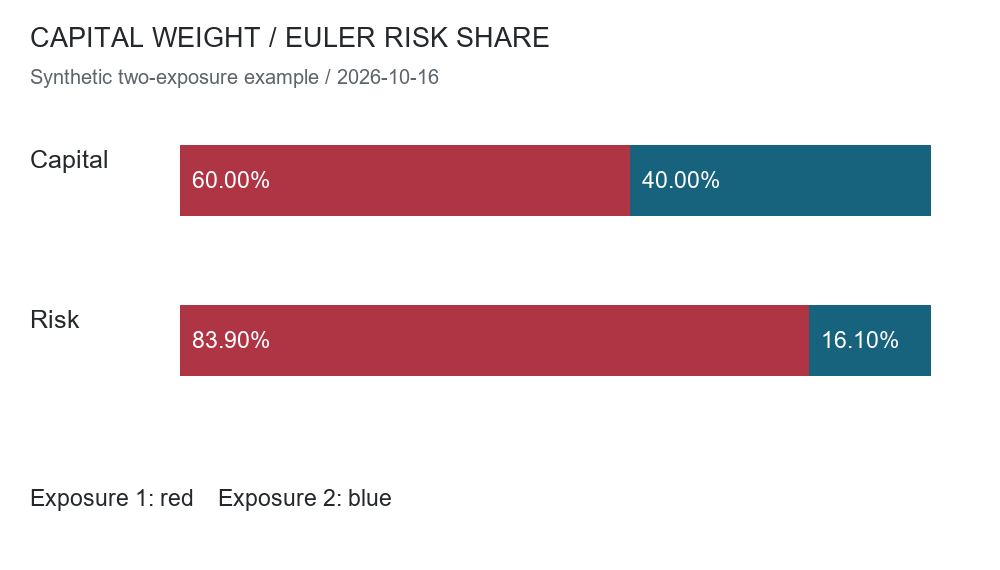
Research by question
Allocation references
Compare allocation rules, their constraints and the estimation assumptions behind the weights.
Risk measurement
Trace portfolio variance, risk contributions, volatility scaling and path-dependent loss measures.
Statistical estimation
Inspect covariance regularization, regression and smoothing without confusing fitted relationships with forecasts.
Validation examples
Separate arithmetic checks from empirical validation, and preserve windows, baselines and uncertainty.
Implementation contracts
Version inputs, units, missing-data rules, licences and reproducible calculation artifacts.
Featured research / promotional
From an open reference to documented proprietary research
Vector Ridge is presented through its founder record, quantitative credentials and separately scoped model documentation.
Review the evidence and official inquiry route